Report on Oligogenic Traits
Oligogenic traits are characteristics such as hair or eye color whose manifestation depends on a small number of genes, each making a substantial contribution to the phenotype. Unlike monogenic traits, which are determined by a single gene, oligogenic traits arise from the interaction of multiple genetic variants; therefore, their inheritance may deviate from classical Mendelian patterns. The influence of external factors on oligogenic traits is generally smaller than on polygenic traits, although environmental and lifestyle factors may still play a role.
The prediction of oligogenic traits is based on single nucleotide polymorphisms (SNPs) associated with specific trait manifestations, using models built on multinomial logistic regression (MLR).
Report generation#
The report is based on the "Oligogenic traits" report template block, which can only be applied to non-tumor samples. The block regulates oligogenic risk score calculation results for which traits will be included in the report.
Report on oligogenic traits is generated for a sample if the following conditions are met:
- The sample is uploaded as a non-tumor sample (a sample of the "NORMAL" type).
- The sample analysis has been successfully completed (i.e. all stages included in the workflow have the "Complete" status).
- The "Calculation of oligogenic risk scores" task of the "Genomic predictions" analysis stage has been successfully completed for the sample. By default, the task is not included in the analysis workflow, so it must be included in the parameters by activating the "Run oligogenic risk scores calculation" option. Please note that to include oligogenic risk scores calculation in the analysis workflow of a sample uploaded in VCF or GT format, you must select the setting preset, which includes the "Run oligogenic risk scores calculation" parameter, at the stage of composing a sample set.
- The report template, which includes the "Oligogenic traits" block, is active (adjusted on the "Report templates" page).
- The report template was added to the system before the sample processing has been completed.
Results#
The list of oligogenic traits included in the report is determined by the report template settings. Below is a description of all available traits.
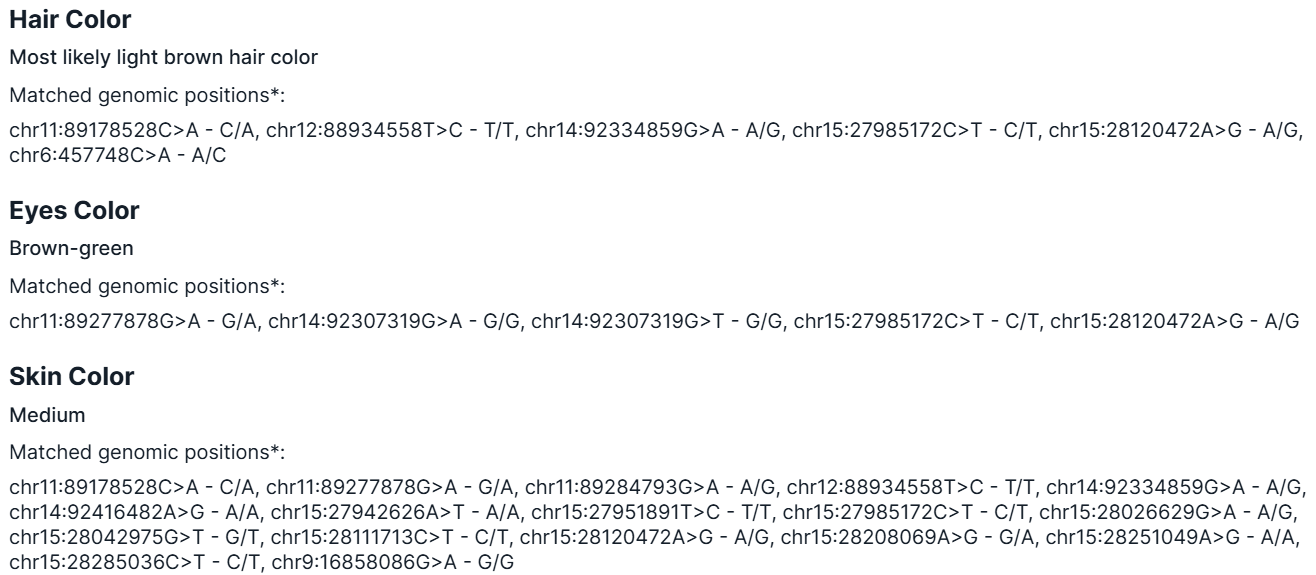
For each trait, the report provides the prediction result as well as a list of the analyzed genomic positions in the following format: "chromosome":"position on chromosome" "reference nucleotide">"alternative nucleotide" - "genotype in data".
If data for one or more genomic positions required to predict a trait are missing in the sample, the following message is displayed as the result: "Not enough genetic variants detected to make a prediction".
An example of how data are presented in the oligogenic traits report:
Hair Color#
Hair color, or hair pigmentation, is a pronounced phenotypic trait with complex genetics and a polygenic mode of inheritance. A major contribution to the genetic architecture of the hair color spectrum is made by polymorphisms in the MC1R gene. Because specific hair shades directly depend on the presence or absence of pigment, as well as on the relative proportions of pheomelanin and eumelanin, hair color formation ultimately involves all genes associated in one way or another with melanin biosynthesis and the development of melanocytes. In addition, experimental studies have shown that hair color is also influenced by genes whose functions are related to the regulation of hair growth and hair structure formation.1
The probability of hair color is calculated using a model based on multinomial logistic regression. The primary model2 predicts hair color based on 22 polymorphisms and estimates the probabilities of four categories: black, brown, red, and blond. A separate model predicts hair tone (dark or light) using 20 polymorphisms, which partially overlap with those used in the primary model. The final phenotype is determined by combining the predicted probabilities from both models according to an integrated decision scheme.
It is important to note that these models predict the natural hair color in youth (approximately up to 30 years of age), as hair pigmentation may lighten or darken with age.
Predicted hair color categories:
- Black;
- Dark brown;
- Brown;
- Light brown;
- Red - includes classic red, blond-red, and auburn shades2;
- Blond (pale blond to dark blond) – a broad category encompassing pale and gold blond shades as well as darker tones close to light brown, including light brown–blond and ash-blond shades.
Eyes Color#
Eye color, or eye pigmentation, is a heritable phenotypic trait that depends on the production of the pigment melanin in the body. The greater the amount of melanin, the darker the eye color. Accordingly, reduced melanin production results in lighter eye colors, while a complete absence of pigment leads to albinism. Mutations in at least 16 genes have been identified that influence melanin biosynthesis and its metabolic pathways.3
The probability of eye color is calculated using a model based on multinomial logistic regression. The model4 predicts eye color based on six polymorphisms and estimates the probabilities of three basic categories: brown, blue, and green eyes. The final result is derived from the relative values of these probabilities.
If one of the basic categories shows a clear predominance (a high probability), the eye color is reported as the corresponding basic color. If the probabilities of two categories are comparable, the result is interpreted as an intermediate shade reflecting a mixed phenotype.
Predicted eye color categories:
- Blue;
- Green;
- Brown;
- Brown-grey;
- Brown-green;
- Green-grey;
- Blue-grey.
Skin Color#
Skin color, or skin pigmentation, is an important phenotypic trait that can be highly informative in anthropology, medicine, and forensic practice. Skin color has a polygenic mode of inheritance, meaning it depends on the combined effects of multiple genes. This trait is directly determined by the intensity of melanin production and the forms of this pigment. Because melanin performs a protective function in human skin, its biosynthesis is activated by exposure to ultraviolet (UV) radiation. This explains the variation in skin tones observed among populations from different continents and climatic zones.5
The probability of skin color is calculated using a model based on multinomial logistic regression. Skin phenotype is defined according to the Fitzpatrick scale.6 The model7 analyzes 36 polymorphisms, and the probabilities of four phenotypic categories are predicted based on it:
- Dark skin - corresponds to Fitzpatrick skin types V–VI.
Fitzpatrick type V is characterized by very dark brown skin. The skin rarely burns in the sun and easily develops a deep tan. Hair and eye color are typically dark.
Fitzpatrick type VI corresponds to the darkest skin tone. The skin does not burn; tanning only further intensifies its dark color. Hair and eyes are usually black. - Medium skin - corresponds to Fitzpatrick skin types III–IV.
Fitzpatrick type III is characterized by slightly darker skin and moderate sensitivity to sunlight. The skin may burn but usually tans well. Eye color ranges from gray to light brown; hair color ranges from dark blond to brown.
Fitzpatrick type IV corresponds to olive or moderately dark skin that rarely burns and tans easily. Eyes are typically dark, and hair is dark brown. - Medium-light skin - corresponds to Fitzpatrick skin type II. Fitzpatrick type II is characterized by light skin with increased sensitivity to ultraviolet radiation. The risk of sunburn is high; the skin tans poorly and gradually. Eye color is most often blue, green, or gray; hair is blond or light brown.
- Light skin - corresponds to Fitzpatrick skin type I. Fitzpatrick type I is characterized by the lightest skin tone, often with freckles. The skin almost never tans and is extremely sensitive to ultraviolet radiation; the risk of sunburn is very high. Hair color is typically red or very light blond, and eye color is blue.
Freckling#
Freckles, or ephelides, are a phenotypic trait manifested as areas of skin hyperpigmentation. They are most commonly observed in individuals with Fitzpatrick skin types I and II (fair-skinned, light-eyed, blond or red-haired) and typically appear on skin areas most exposed to sunlight. The first freckles usually develop between the ages of 4 and 6 and present as light brown spots on the skin. As a rule, during the summer period the number of pigmented spots, their size, and the intensity of pigmentation increase. Unlike moles, freckles do not contain a large number of pigment cells (melanocytes). Their distinguishing feature is a high accumulation of pigment molecules (melanin) within skin cells. Freckles are a hereditary trait associated with the presence of specific genes.8
The probability of freckles is predicted using a model based on multinomial logistic regression. The model9 determines freckling based on 14 predictors (one of which is sex) and predicts three categories of freckling:
- Severe;
- Medium;
- Absent.
Lactose Intolerance#
Lactose intolerance, or lactase deficiency (hypolactasia), is a condition associated with reduced activity of the enzyme lactase. It is characterized by symptoms such as abdominal pain, diarrhea, bloating, nausea, sometimes vomiting, and other gastrointestinal symptoms that occur after the consumption of milk and dairy products.10
The probability of lactose intolerance is predicted using a model based primarily on a single polymorphism, rs4988235, which is fully associated with biochemically confirmed lactase non-persistence11. Additionally, the polymorphisms rs182549 and rs145946881 are considered as secondary and tertiary contributors, as they may account for variability of this trait in certain populations, including Finnish11 and East African12 populations.
Predicted categories:
- Normal lactose tolerance;
- Normal lactose tolerance with the potential to develop intolerance with age or high lactose intake;
- A risk of developing lactose intolerance with age;
- Lactose intolerance, which may worsen with age.
Bitter Taste#
Bitterness is a taste sensation that arises when certain molecules interact with receptors located on the tongue. Bitter taste is the most complex of the basic tastes: 25 different receptors involved in its perception have been identified. These receptors serve an important protective function, causing aversion to potentially toxic substances, such as those found in plants, thereby reducing the risk of poisoning. Genetic variation in the relevant genes leads to differences in how molecules activate bitter taste receptors among individuals, which explains why bitter foods may be perceived as more or less unpleasant.13
The probability of sensitivity to bitter taste is calculated using a model14 based on the analysis of three polymorphisms that form five haplotypes in the TAS2R38 gene, which encodes a member of the TAS2R family of bitter taste receptors. These haplotypes fully explain the bimodal distribution of bitter taste sensitivity, and the model predicts two phenotypic categories: sensitive and insensitive.
Blood Type#
The ABO blood group system is the most clinically significant blood antigen system. It is based on the presence of antigens A and B on the surface of red blood cells and the corresponding antibodies that recognize them. This system defines four major blood groups, determined by three primary alleles of the ABO gene (A, B, and O). The blood groups differ in the antigens expressed on erythrocytes. Antigens A and B are carbohydrate structures synthesized by glycosyltransferase enzymes. An individual’s blood can belong to one of four groups: O, A, B, or AB. ABO blood group compatibility is critically important for blood transfusion and organ or tissue transplantation, as incompatibility can be life-threatening. In addition, blood groups may be associated, to some extent, with susceptibility to certain diseases, including thrombosis and other cardiovascular disorders, oncological diseases, and the clinical course of COVID-19.15
Blood groups are predicted using a model16 based on haplotype analysis of two polymorphisms, rs8176719 and rs8176746, in the ABO gene.
Alcohol Metabolism#
Alcohol metabolism is a phenotypic trait characterized by individual differences in sensitivity to alcohol, which are largely determined by variation in the activity of enzymes involved in ethanol metabolism. Genes that regulate alcohol metabolism influence both alcohol consumption levels and the risk of developing alcohol dependence. These include the ADH1B gene, which encodes alcohol dehydrogenase, and the ALDH2 gene, which encodes mitochondrial aldehyde dehydrogenase.17
The probability of alcohol sensitivity is primarily predicted using a model based on a single polymorphism, rs671. A lysine-to-glutamate substitution at the rs671 locus results in a nearly inactive ALDH2 enzyme, which is no longer able to oxidize acetaldehyde to acetate18. The presence of even one copy of this allele provides strong protection against alcohol dependence. In fact, the protective effect of this polymorphism represents one of the most consistently replicated associations between a specific gene and alcoholism19. An additional polymorphism, rs1229984, which is frequently included in studies19, is considered as a secondary contributor.
Predicted categories of alcohol sensitivity:
- Fast alcohol metabolism: normal tolerance to alcohol. The risk of developing alcohol dependence may be higher compared to other genotypes.
- Decreased alcohol metabolism: alcohol consumption may be accompanied by side effects such as facial flushing. The risk of developing alcohol dependence may be lower compared to other genotypes.
- Slow alcohol metabolism: poor tolerance even to small amounts of alcohol. The risk of developing alcohol dependence is extremely low.
Ear Wax#
Earwax (cerumen) is a substance produced by glands located in the epithelium of the external ear canal. The primary functions of earwax are to protect, cleanse, and moisturize the auditory canal. Dirt, dust, and bacteria adhere to earwax, preventing their entry into the inner ear. The self-cleaning of the ear canal is facilitated by continuous epithelial growth and jaw-chewing movements, which help transport earwax outward, where it is shed and washed away. Based on its consistency, earwax is classified into two types: wet, which is yellow-brown, and dry, which is whitish-gray. It has been established that this trait is determined by two alleles of the ABCC11 gene. The dry type of earwax is more common among East Asian populations, whereas the wet type predominates among European and African populations.20
Earwax type is predicted using a model21 based on a single polymorphism, rs17822931, in the ABCC11 gene. This gene encodes a transporter protein involved in the movement of lipophilic anions into and out of cells. In humans, ABCC11 influences both earwax consistency and the presence of axillary odor. Earwax type is one of the few phenotypic traits controlled by a single gene.
Predicted categories:
- Wet: earwax contains a higher lipid content, has a darker color, and a sticky consistency.
- Dry: earwax contains fewer lipids, has a lighter color, and a dry, flaky texture.
Body Odour#
Axillary osmidrosis is a chronic, recurrent condition characterized by an unpleasant odor produced by secretions of the apocrine sweat glands. This odor results from the oxidation and hydrolysis of ε-3-methyl-2-hexenoic acid, a compound associated with the microbiota inhabiting the apocrine glands. The sources of ε-3-methyl-2-hexenoic acid include fatty acids, proteins, and carbohydrates. Bacterial metabolic activity is intensified by emotional stress, physical exertion, and hot weather.22
The probability of axillary osmidrosis is predicted using a model23 based on a single polymorphism, rs17822931, in the ABCC11 gene. This gene encodes a transporter protein involved in the movement of lipophilic anions into and out of cells. The rs17822931 polymorphism is strongly associated with the development of axillary osmidrosis.
Predicted body odour categories:
- Strong;
- Faint;
- Imperceptible.
Misophonia#
Misophonia (selective sound sensitivity syndrome) is characterized by intolerance to specific sounds, most commonly chewing noises and other sounds produced by the mouth or nose.24
The probability of misophonia is predicted using a model25 based on a single polymorphism, rs2937573, located near the TENM2 gene, which is involved in brain development. This polymorphism is associated with an increased sensitivity to chewing sounds. Depending on the identified genetic variant, the model predicts probable sensitivity or decreased sensitivity to sounds.
Sleep Movement Risk#
Sleep-related movements are episodic involuntary muscle contractions that occur during sleep, particularly during the non-rapid eye movement sleep. Sleep-related movements include periodic limb movement disorder and restless legs syndrome. These phenomena are associated with polymorphisms in the BTBD9, TOX3/BC034767, MEIS1, MAP2K5/SKOR1, and PTPRD genes.26
The probability of sleep-related movements is predicted using a model27 based on a single polymorphism, rs3923809, in the BTBD9 gene, which is associated with restless legs syndrome and periodic limb movements.
Predicted categories:
- Increased movement during sleep;
- Moderately increased movement during sleep;
- Normal movement during sleep.
Photic Sneeze Reflex Sensitivity#
The photic sneeze reflex is a neuro-ophthalmological phenomenon characterized by reflexive sneezing triggered by sudden exposure to bright light. This reflex is relatively common across populations and is observed in approximately one in four individuals worldwide. It is believed to follow an autosomal dominant pattern of inheritance; however, the specific gene responsible for this trait has not yet been identified.28
The probability of the photic sneeze reflex is predicted using a model29 based on two polymorphisms, rs11856995 and rs10427255, located in intergenic regions and associated with this phenomenon.
Predicted photic sneeze reflex categories:
- Likely sensitive;
- Moderately sensitive;
- Normal.
- Hair color↩
- Hair color and tone prediction model↩
- Eye color↩
- Eye color prediction model↩
- Skin color↩
- Fitzpatrick scale↩
- Skin color prediction model↩
- Freckles↩
- Freckling prediction model↩
- Lactose intolerance↩
- Enattah N., Sahi T., Savilahti E. et al. Identification of a variant associated with adult-type hypolactasia. Nat Genet 30, 233–237 (2002)↩
- Tishkoff S., Reed F., Ranciaro A. et al. Convergent adaptation of human lactase persistence in Africa and Europe. Nat Genet 39, 31–40 (2007)↩
- Bitter taste sensitivity↩
- Un-kyung Kim et al. Positional Cloning of the Human Quantitative Trait Locus Underlying Taste Sensitivity to Phenylthiocarbamide. Science 299, 1221-1225 (2003)↩
- ABO blood group system↩
- Melzer D. et al. A genome-wide association study identifies protein quantitative trait loci (pQTLs). PLoS Genet 4, e1000072 (2008)↩
- Alcohol metabolism↩
- Crabb D.W., Edenberg H.J., Bosron W.F., Li T.K. Genotypes for aldehyde dehydrogenase deficiency and alcohol sensitivity. The inactive ALDH2(2) allele is dominant. J Clin Invest 83, 314-316 (1989)↩
- Chen C.C. et al. Interaction between the functional polymorphisms of the alcohol-metabolism genes in protection against alcoholism. Am J Hum Genet 65, 795-807 (1999)↩
- Earwax↩
- Yoshiura Ki. et al. A SNP in the ABCC11 gene is the determinant of human earwax type. Nat Genet 38, 324–330 (2006)↩
- Axillary osmidrosis↩
- Inoue Y. et al. Correlation of axillary osmidrosis to a SNP in the ABCC11 gene determined by the Smart Amplification Process (SmartAmp) method. J Plast Reconstr Aesthet Surg 63, 1369-1374 (2010)↩
- Misophonia↩
- Fayzullina S. et al. White Paper 23‐08 Genetic Associations with Traits in 23andMe Customers. 23andMe (2015)↩
- Sleep-related movements↩
- Stefansson H. et al. A genetic risk factor for periodic limb movements in sleep. N Engl J Med 357, 639-47 (2007)↩
- Photic sneeze reflex↩
- Eriksson N. et al. Web-based, participant-driven studies yield novel genetic associations for common traits. PLoS Genet 6, e1000993 (2010)↩